6 Signs Your Artificial Turf Needs Professional Cleaning
Artificial turf requires significantly less maintenance than natural grass, but it is not maintenance-free. Organic debris, pet waste, infill migration, compacted fibers, and the buildup of dust and particulates all accumulate over time and can affect both the appearance and performance of your synthetic grass. Most homeowners manage routine upkeep with periodic rinsing and occasional brushing. But there are six specific signs that your turf has reached a point where professional cleaning will make a meaningful difference that DIY care cannot achieve.
Sign 1: Persistent Odor That Does Not Clear After Rinsing
A mild odor after rain or during hot weather is normal, particularly in pet turf areas. It is caused by bacterial activity in organic material that has accumulated in the infill layer. Rinsing the surface with water disperses surface odors temporarily.
When the odor returns quickly after rinsing, or when you can detect it from a distance without recent rain or heat as a trigger, the organic load in the infill has exceeded what rinsing can address. Bacteria are establishing and reproducing in the infill rather than simply sitting on the surface. Professional cleaning includes deep infill agitation, enzyme-based bacterial treatment, and deodorizing agents that penetrate to the base of the infill layer where the organic accumulation has concentrated. Regular rinsing does not reach this layer effectively.
Pet turf in high-use areas in North Texas typically reaches this threshold within 12 to 18 months of installation without periodic professional treatment, depending on the number and size of dogs and how frequently the surface is rinsed.
Sign 2: Matted or Flattened Fibers That Do Not Recover
Artificial turf fibers are designed to stand upright. They deflect under load and return to position when the load is removed. Over time and under repeated traffic in specific zones, fibers can develop a permanent lay in one direction and lose their ability to spring back naturally.
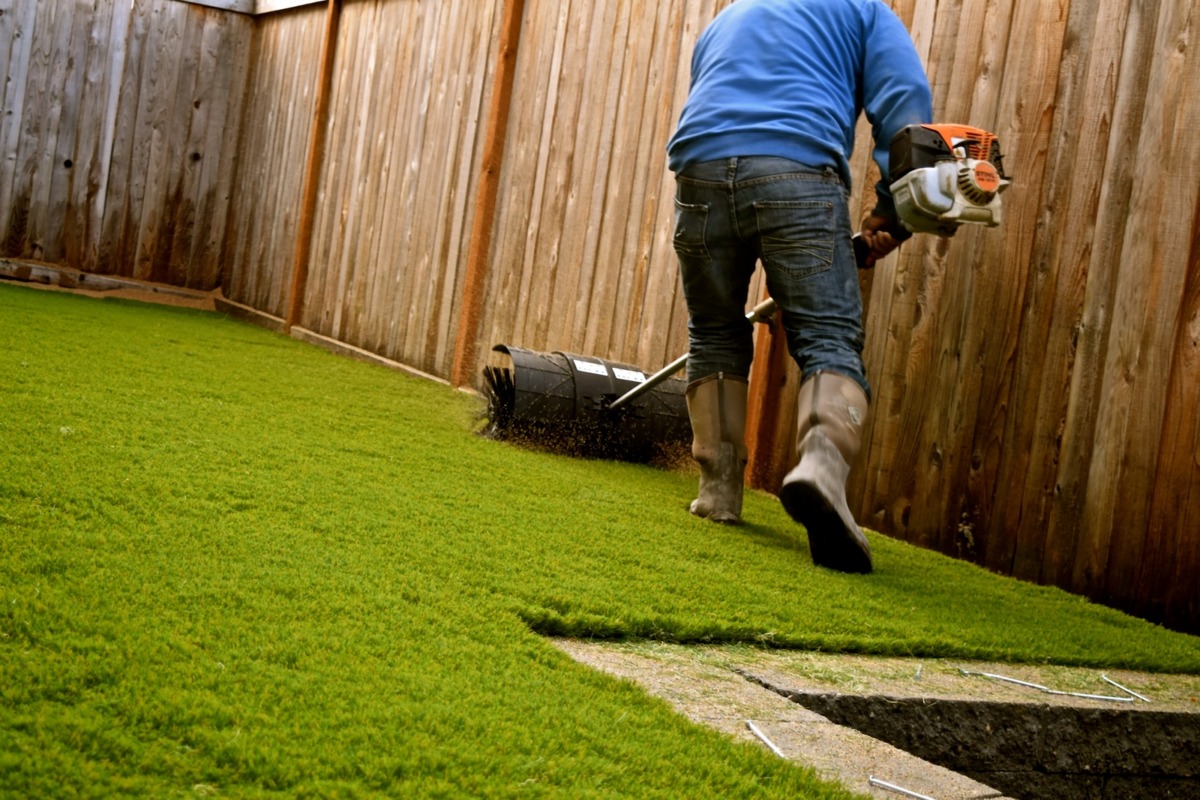
Light matting can often be addressed with a stiff-bristle brush or a power broom. When matting is widespread, concentrated in high-traffic paths, or accompanied by fibers that have become brittle or discolored, professional cleaning combined with deep power brushing can restore much of the original fiber orientation. In some cases, additional infill application is needed to support the fiber base and allow better recovery.
In North Texas, high-traffic zones under outdoor furniture, along dog paths, and at entry points to the yard are the first areas to show matting. These areas benefit most from periodic professional brushing and infill maintenance.
Sign 3: Visible Organic Buildup or Discoloration
Artificial turf in an outdoor environment accumulates organic material continuously: pollen, leaf litter, seed pods, insect debris, and airborne particulates all settle into the turf surface and infill. In DFW, oak and cedar pollen seasons are particularly heavy, and the fine particles penetrate deep into the turf pile where they are not easily removed by rinsing.
When this accumulation becomes visible as a layer of brownish debris at the base of the fibers, or when sections of turf appear discolored or dull compared to recently installed areas, the organic load has built up enough to affect appearance and to provide a substrate for weed germination at the edges of the installation. Professional cleaning removes this layer through a combination of power brushing, vacuuming, and rinsing with sufficient water volume and pressure to flush material through the backing.
Sign 4: Weed Growth at the Seams or Edges
A properly installed artificial turf system includes a weed barrier beneath the base layer. Weeds do not grow up through this system from below in normal conditions. When weeds appear on artificial turf, they are almost always germinating in organic material that has accumulated on top of the turf surface or in the infill, not in the soil below.
Weed growth at seam lines and edges, where debris tends to accumulate, is the first sign that the organic layer on top of the turf has become deep enough to support germination. This is also a sign that the edge restraints or seam adhesive may have degraded slightly, creating gaps where debris collects. Professional cleaning clears the organic material and allows a proper inspection of seam and edge integrity at the same time. Learn more about our repair and maintenance services at northtexasluxurylawns.com/turf-cleaning-maintenance/.
Sign 5: Infill Has Migrated or Become Uneven
Infill is the granular material applied between turf blades during installation. It performs several functions: supporting blade orientation, adding cushioning, weighting the turf against wind, and optimizing drainage performance. Over time, infill migrates under traffic patterns, washes to low areas during heavy rain, or compacts unevenly across the installation.
When infill has migrated significantly, you may notice areas where turf blades lie flat without support, sections where the surface feels noticeably harder or softer than others, or visible bare spots at the base of fibers where infill has washed out. Professional service includes infill redistribution or top-up application to restore even coverage. In DFW, where heavy rain events are common, infill migration in low spots is a regular maintenance item for installations that have been in place three years or more.
Sign 6: The Turf Has Not Been Professionally Serviced in Three or More Years
Many homeowners ask how often professional turf cleaning is recommended. There is no single correct answer for every installation, because use intensity, pet activity, tree coverage, and climate exposure all affect the maintenance timeline. A general guideline for North Texas conditions: high-pet-use installations benefit from professional service annually. Moderate-use residential lawns every two to three years. Commercial installations with high foot traffic may need service more frequently.
If your turf has not had a professional cleaning since installation and it has been three or more years, a service visit is worth scheduling regardless of whether you have noticed specific problems. Professional service often identifies and addresses minor issues before they become visible, including early-stage seam separation, infill deficiencies, and edge deterioration.
Professional Turf Cleaning From the Company That Installed It Right
North Texas Luxury Lawns & Greens provides professional turf cleaning and maintenance service for existing synthetic grass installations throughout the Dallas-Fort Worth Metroplex, including installations we completed and installations by other companies. Our service includes deep infill agitation, enzyme-based odor treatment, power brushing for fiber restoration, organic debris removal, infill inspection and top-up as needed, and a full seam and edge inspection.
We are BBB A+ accredited with a 5-star Google rating. Our service team is the same in-house crew that installs our turf. Call (972) 412-6569 or schedule service at northtexasluxurylawns.com/turf-cleaning-maintenance/. We serve Dallas, Plano, Garland, Frisco, McKinney, Allen, Murphy, and the surrounding DFW communities.