
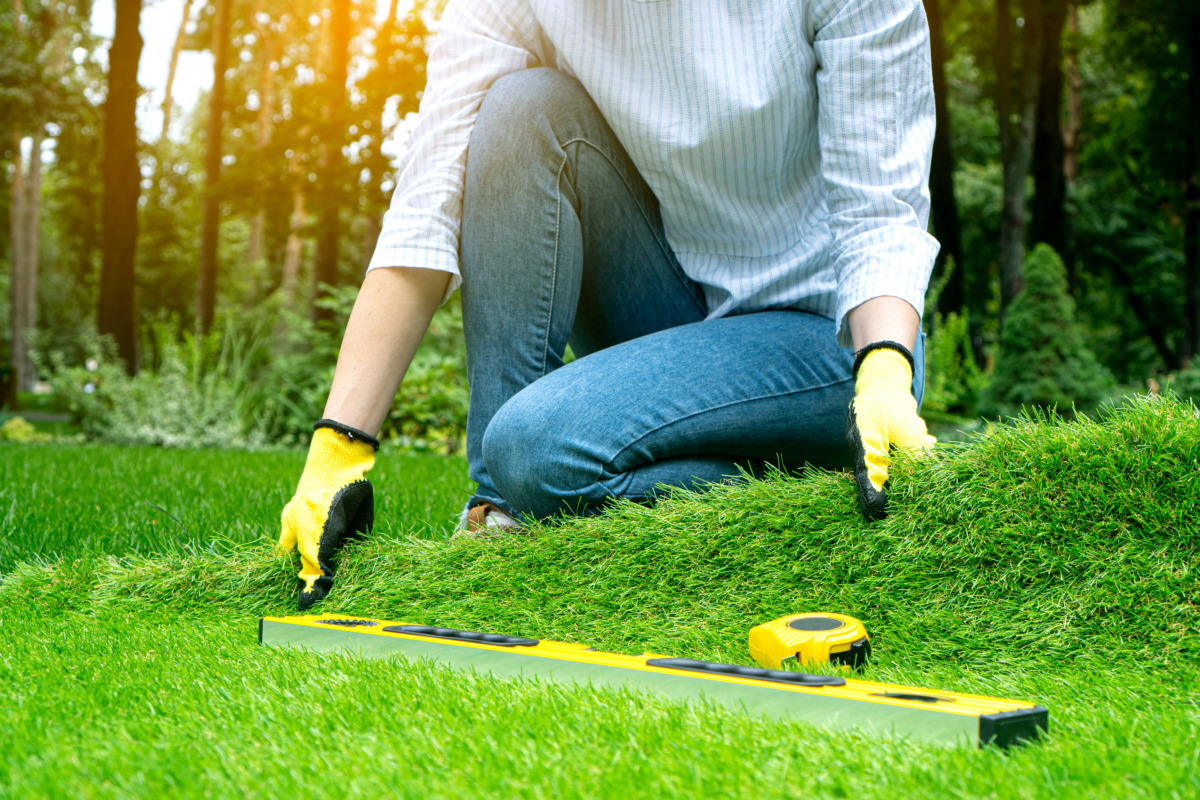
Artificial Turf Repair in North Texas: What Can Be Fixed and What Needs Replacement
Most artificial turf problems in North Texas can be repaired. Open seams, lifted edges, burn spots, thin infill, small tears, pet damage and localized soft spots are all routine repairs. Turf needs replacement when the fibers themselves have broken down across the whole surface (fading, splitting, shedding), when the backing has become brittle, or when the base has failed badly enough that the turf would have to come up anyway. Below is how we tell the difference on a repair inspection, and what each fix involves.
What breaks on artificial turf in DFW, and why
Synthetic turf is a system: a compacted aggregate base, a perforated backing, the fibers, and the infill that holds the fibers upright. Almost every failure traces to one of those layers, and North Texas is hard on all four.
- Heat and UV. The National Weather Service’s DFW climate normals count 20.2 days a year at 100 degrees or above. Heat softens seam adhesive, and years of UV eventually degrade fibers on lower-grade products.
- Clay soil movement. Blackland clay swells when wet and shrinks when dry. A base that was not compacted deeply enough moves with it, and the turf above it develops soft spots, ripples and open seams.
- Spring downpours. With 37.01 inches of normal annual rainfall, much of it in heavy spring storms, a base without positive drainage washes out at the edges.
- Traffic and pets. Dogs dig corners and chew edges, furniture flattens fibers, and foot paths wear infill thin.
- Reflected heat and fire. Low-E windows, grills and fire pits melt or singe fibers in a small area.
Problems that can be repaired
Open or separated seams
The most common turf repair call. Seams open when the seam tape or adhesive fails, when the base shifts beneath the joint, or when heavy traffic crosses the seam repeatedly. Repair means lifting the seam, cleaning and re-seating the base if needed, installing new seam tape and adhesive, weighting the joint while it cures, and brushing infill back in. A seam that keeps opening is usually a base problem, which is why we inspect before we glue.
Lifted or shrinking edges
Edges along patios, curbs and bed borders lift when perimeter fastening fails or when the turf was not secured against thermal movement. We re-trench or re-nail the perimeter, add bender board or edge restraint where none exists, and re-secure the turf.
Burns, melts and stains
A grill coal, a dropped sparkler or a window reflection damages a small area. We cut out the damaged section, install a matched patch with seam tape on all sides, and blend the fibers. On turf we installed, we match the exact product. On other turf, we match as closely as the market allows and place the seam where it is least visible.
Thin or compacted infill
When fibers lie flat and the turf feels hard, the infill has compacted or worn away. This is a cleaning-and-infill job: power brushing to decompact, then infill top-up and leveling. It is the least expensive repair on the list and the one most often mistaken for “worn out turf.”
Soft spots and minor sinking
A localized soft area means the base has settled or washed out beneath it. We lift the turf, rebuild and compact the base in that zone, and re-seam. This is a true repair as long as the problem is confined to a section rather than the whole lawn.
Pet damage and small tears
Chewed edges and dug corners are patched or re-secured the same way as burns and edges. If the dog keeps targeting one spot, we also look at why: a gap under the edge, a smell in the backing, or loose infill.
Drainage that has slowed
Turf that pools water after rain but drained well when new usually has compacted infill and a layer of fine debris in the backing. A deep clean fixes it. If the pooling is new and localized, see soft spots above. Our turf cleaning, repair and maintenance page covers both.
Problems that usually mean replacement
- Fiber breakdown across the whole surface. Fading to grey or white, blades splitting into fine strands, fibers shedding when brushed. This is UV degradation and it cannot be reversed with cleaning or infill.
- Brittle or cracked backing. If the backing crumbles or tears when a seam is lifted, patches will not hold.
- Widespread base failure. Ripples, ridges and soft spots across most of the area mean the base was never built correctly. The turf has to come up to fix it, and turf that has been down for years rarely survives removal and reinstallation.
- Repeated repairs in the same places. When you are calling for the third seam repair on the same lawn, the cost of fixes starts to approach the value of starting over.
- Turf that was never right for the use. Landscape turf installed in a dog run or a batting cage will keep failing. Replacement with the correct product ends the cycle.
The Synthetic Turf Council’s guidelines for synthetic turf landscape installation and base systems describe what a proper base and installation look like. When an existing installation misses those basics, replacement is often the honest recommendation. For how long a well-built system should last in our climate, see our article on the lifespan and durability of synthetic grass.
How we decide on a repair inspection
- Walk the whole area, not just the spot you called about, and mark every seam, edge and soft spot.
- Lift a seam or edge to check the backing condition and the base beneath it.
- Test drainage with water in the low spots.
- Check fiber condition by brushing a high-sun area and looking for splitting or shedding.
- Estimate the repair area as a share of the total. A few sections of a sound installation get repaired. Most of a failing installation gets replaced, and we say so.
Most repairs are completed in a single visit. Seam and edge work needs cure time before the area is walked on, usually until the next day, and section replacements depend on how quickly matching turf can be sourced. Base rebuilds under a soft spot take longer because the zone has to be excavated, compacted and re-seamed.
You receive a written recommendation either way. We do not sell a replacement when a repair will hold, and we do not sell a repair that we expect to fail next summer.
Turf repair and replacement across North Texas
We repair and replace turf we installed and turf we did not, across Dallas, Fort Worth, Plano, Frisco, McKinney, Celina, Wylie, Sachse, Garland, Allen, Irving and Arlington. Replacement projects follow the same process as a new artificial grass lawn installation: removal, base rebuild, drainage correction, new turf, infill and inspection.
When to call North Texas Luxury Lawns & Greens
If you can see a seam, lift an edge, feel a soft spot or smell the backing, it is time for an inspection, and earlier is cheaper. North Texas Luxury Lawns & Greens has specialized exclusively in artificial turf since 2015, holds an A+ Rating by the Better Business Bureau and a 5-star rating on Google, uses in-house crews only, and backs every job with owner Bo Freeman’s money-back guarantee.
Call (972) 412-6569 or request a turf repair inspection online and we will tell you honestly whether your turf needs a fix or a fresh start.